Transformer Turns Ratio Test (TTR) Explained: Purpose, Procedure, and Results
Making sure your transformers function efficiently and safely isn’t just an exercise in technical terms; it’s a crucial aspect of safeguarding all electrical resources. The most important tests to determine the condition of a transformer would be the Transformer Turns Ratio Test (TTR). It doesn’t matter if you’re overseeing the distribution transformer or a power transformer; knowing TTR is crucial. Companies such as U.K Electric Co. emphasize TTR as part of the Transformer Repair & Maintenance Services to ensure operational reliability as well as long-term efficiency.
We’ll discuss what the Transformer Turns Ratio Test is and why it’s so important, how it’s conducted and how to analyze the results. We’ll also discuss relevant transformer diagnostics and maintenance techniques, mixing the technical knowledge with practical application.
What is the Transformer Turns Ratio Test (TTR)?
It is the Transformer Turns Ratio Test, commonly abbreviated as TTR, which examines the ratio between primary and secondary windings within the transformer. In essence, it confirms that the transformer’s configuration of windings is in line with its specifications for design. Any deviation from the ratio can be a sign of transformer issues with the windings, for example, broken connections, shorted turns or degradation due to the aging process.
Achieving accurate TTR measurements is vital for measuring the transformer’s voltage ratio and ensuring the reliability of operation within the electrical system. As per IEEE Standard C57.12.90, completing TTR measurements is required for all transformers, including new ones for commissioning as well as older transformers in preventive maintenance.
Why Perform a Transformer Turns Ratio Test?
The TTR test has multiple uses:
- Verify Electrical Integrity – Confirm that the transformer’s electrical components are properly connected and working.
- Finding Winding Problems Early Helps to identify damaged or shorted turns or open circuits prior to they cause costly breakdowns.
- Make sure voltage accuracy is maintained – Ensures an accurate transformer, vital for grid stability.
- Tests the condition of support transformers. Offers information for the analysis of predictive and efficiency of maintenance.
If there are no regular TTR tests, the transformers are at a greater risk of being less efficient, as well as having fault prevention failures and outages that are unexpected. U.K Electric Co., an established provider of repair services for transformers, integrates TTR into its comprehensive Transformer Repair & Maintenance Services to ensure the health of equipment.
How the Transformer Turns Ratio Test is Conducted
Conducting TTR tests is a TTR test requires a series of specific steps to ensure the accuracy of measurements and diagnostic accuracy:
1. Preparation
- Remove it from your system, and make sure that it is not energized.
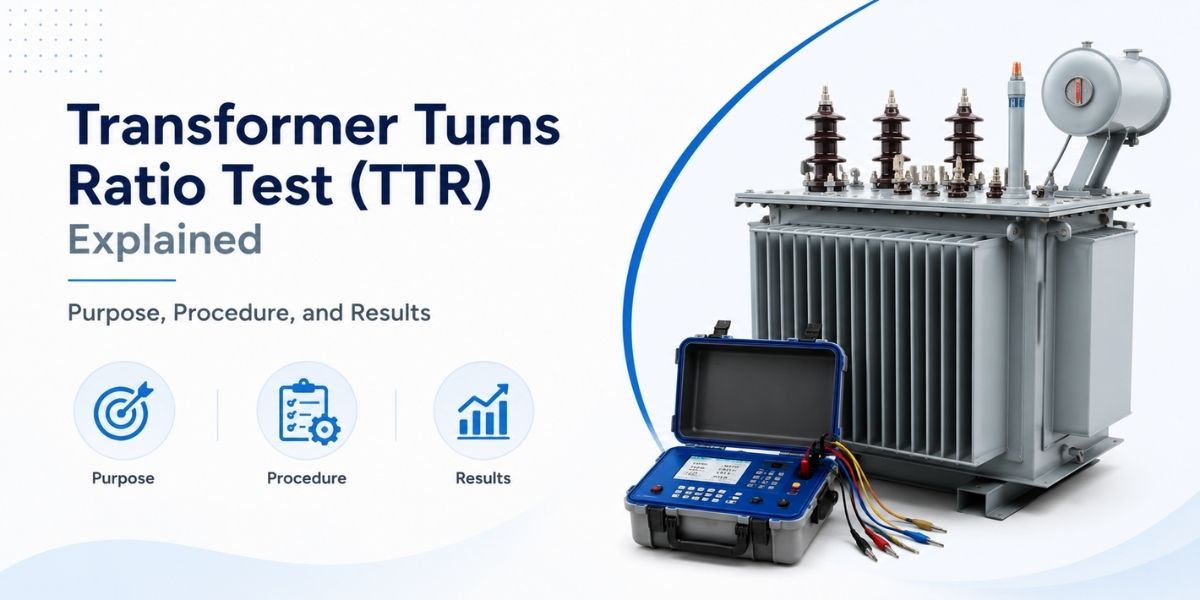
- Make sure that the instruments you are testing, such as the TTR Meter, are calibrated to ensure test consistency.
2. Connection
- Connect the TTR Meter with the secondary and primary windings in accordance with the instructions of the manufacturer.
- Make sure that all connections are in compliance with standards for safety, protecting both equipment and personnel.
3. Measurement
- Make a low-voltage electrical signal the main winding.
- Determine the output voltage of the secondary winding to determine how much winding is used.
- The ratio you measure should be compared with the design or nameplate specifications.
4. Analysis
- Calculate winding ratio deviation. Variations that are beyond IEEE and IEC tolerances may indicate that an analysis of the transformer’s winding fault is necessary.
- Review the results to determine the reliability of operation, performance verification and stability of the system.
TTR testing is applicable to any type of transformer, such as Current transformers (CTs), as well as potential transformers (PTs), distribution transformers, auto transformers, and power transformers.
Interpreting TTR Test Results
Knowing TTR results requires careful consideration of the numeric deviation as well as the context of the system:
- Within tolerance, the transformer is operating normally. Small variations are likely because of manufacturing tolerances.
- A slight deviation could signal the beginning of signs of wind aging or minor insulation problems. It is necessary to monitor the condition.
- Significant Deviation: Signifies severe winding problems like connections that are not working, shorted turns or mechanical damage that require repair services for transformers.
Regular TTR tests help with the maintenance of the transformer by providing useful information on the health of the transformer as well as the overall health of the equipment.
Benefits of Regular TTR Testing
- Asset Protection: Preventing faults early can avoid catastrophic failures.
- Operational Reliability: Ensures the accuracy of voltage and a consistent performance.
- Maintenance Efficiency: Helps technicians prioritize repairs and replacements.
- Performance Optimization: Aids in the assessment of the performance of transformers and quality assurance tests.
- Safety Compliance: The goal is to reduce the risk of electrical hazards in operation.
Through the integration of TTR into routine inspections, organizations can enhance calibration of equipment as well as technical evaluation and risk mitigation, which contributes to a longer lifespan of the transformer and better stability of the system.
TTR in the Context of Transformer Commissioning and Diagnostics
TTR does not function as an individual test. It is an integral part of a wider diagnostics program for electrical transformers, which includes:
- Transformer insulation testing – Verifies dielectric integrity.
- Checks the integrity of the transformer’s winding. Verifies electrical and mechanical quality.
- Evaluation of the performance of transformers – Measures the efficiency of the transformer under loads.
- Tests for commissioning of transformers – Assures the grid is ready for connection.
For companies such as U.K Electric Co., the combination of TTR along with this test will ensure the reliability of tests and accuracy in diagnosing and building confidence with Transformer Repair & Maintenance Services.
Ensuring Transformer Reliability: Key Takeaways from the TTR Test
The Transformer Turns Ratio Test is a cornerstone of transformer maintenance and quality assurance. By performing TTR tests, electrical engineers can detect winding faults, validate transformer accuracy, and optimize system performance. Trusted providers like U.K Electric Co. use TTR as part of comprehensive transformer repair services and preventive maintenance strategies to ensure equipment health, asset protection, and operational reliability.
For any organization relying on transformers, whether for distribution, power, or instrumentation, TTR testing is an essential step for fault prevention, performance optimization, and long-term system stability.
If you are looking for expert support in transformer diagnostics, testing, or maintenance, contact U.K Electric Co. today for professional assistance and reliable Transformer Repair & Maintenance Services. Our team ensures accurate testing, timely troubleshooting, and dependable solutions to keep your electrical systems running safely and efficiently.