
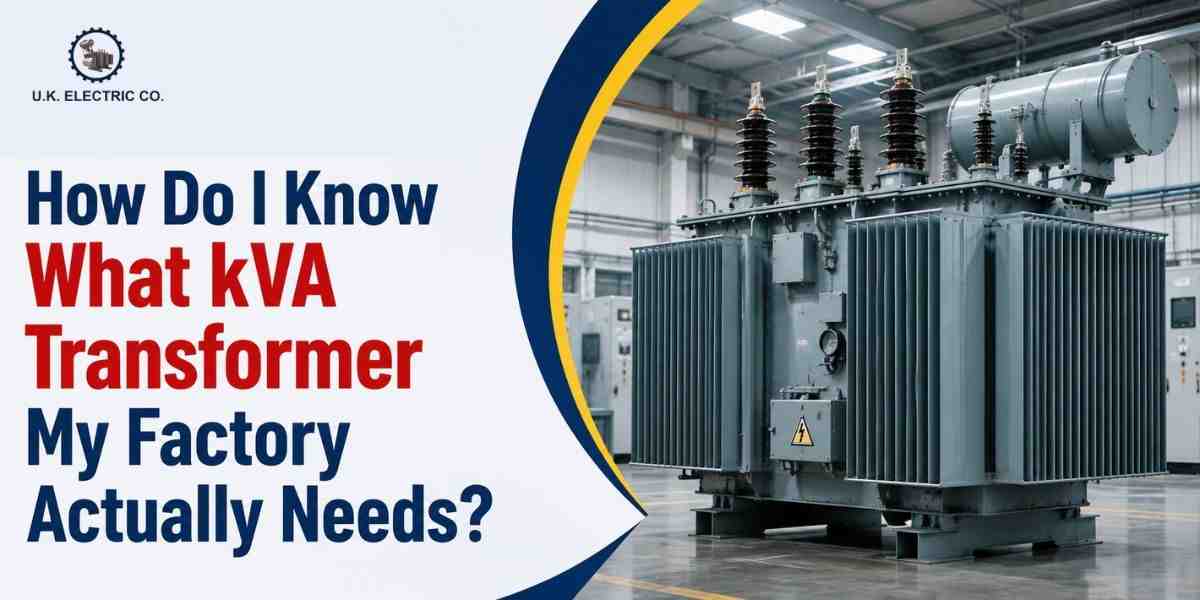
How Do I Know What kVA Transformer My Factory Actually Needs?
Choosing a transformer for a factory is not a case of looking at the biggest machine on the floor and saying, “That should do it.” Electrical systems are a little less forgiving than that.
The right transformer needs to support your actual electrical demand, maintain a reliable power supply, handle starting conditions, and leave sensible room for your operating plans. If you are working with a certified Company, the same load information can also help the service team understand whether an existing unit is being pushed beyond its practical operating conditions.
For businesses such as U.K Electric Co., transformer sizing and maintenance go hand in hand. A correctly selected transformer can support factory operations, while proper inspection and testing help identify whether an existing unit continues to perform as expected. U.K Electric Co. publishes services covering power and distribution transformer repair, maintenance, testing, rewinding, oil dehydration and filtration.
Why Transformer kVA Matters in a Factory
Before starting a transformer kVA sizing calculation, it helps to understand what kVA actually represents.
Transformers receive a kVA transformer rating because their windings and other components must handle voltage and current. For a three-phase system, Schneider Electric gives the basic apparent-power relationship as:
kVA = √3 × Voltage × Current ÷ 1,000
If your load information comes in kW instead, you also need the power factor. Schneider Electric explains that you can calculate the required apparent power by dividing kW by power factor. Ignoring power factor can result in an undersized transformer.
In simple terms, kW tells you about real power, while kVA accounts for the total apparent power that the electrical equipment must handle.
That distinction becomes especially important in factories with motors, drives and other industrial equipment.
Start With Your Factory’s Connected Load
The first step in transformer sizing for factory applications is to create a proper electrical load schedule.
List the major equipment connected to the electrical system, such as:
- Motors
- Pumps
- Compressors
- CNC machines
- HVAC equipment
- Furnaces and heaters
- Welding equipment
- Lighting
- Production machinery
- Office and auxiliary loads
Record the information available on each transformer nameplate, machine nameplate or equipment specification. Where available, note the rated kW or kVA, voltage, current, power factor and operating conditions.
This gives you the connected load.
However, connected load does not automatically equal the transformer capacity your factory needs.
A factory may have 500 kW of installed equipment but may not operate every machine at full load simultaneously. That is why a proper electrical load calculation for factory operations should consider actual operating patterns.
Connected Load vs. Maximum Demand
Imagine a factory has several production lines. Some operate continuously, some operate in batches, and others only run during particular production stages.
Adding every nameplate rating together may therefore exaggerate the actual simultaneous demand.
Your transformer load calculation should instead examine the maximum demand that the transformer is realistically expected to supply.
That means looking at:
- Which machines run simultaneously
- Typical operating loads
- Production schedules
- Peak operating periods
- Motor starting requirements
- Existing measured demand, where available
- Planned additional equipment
This approach gives you a much better basis for transformer capacity calculation than simply adding nameplate ratings.
Convert kW into kVA
Once you have a realistic maximum demand, consider power factor.
The basic relationship is:
kVA = kW ÷ Power Factor
For example, suppose your calculated maximum demand is 400 kW and the relevant operating power factor is 0.90.
400 ÷ 0.90 = 444.4 kVA
That 444.4 kVA figure represents the calculated apparent-power requirement under those assumptions.
It does not automatically mean that you should order a transformer with exactly that rating. The final transformer capacity selection needs to consider the available standard rating, operating conditions, starting loads, future requirements and applicable design requirements.
Power factor matters because lower power factor means more apparent power for the same real-power demand. That can increase current and therefore affect the required transformer load capacity. Schneider Electric specifically warns that failing to account for power factor can lead to transformer undersizing.
Don’t Forget Motor Starting Loads
This is where many basic industrial transformer sizing calculations can become misleading.
A factory may have a moderate running load but several large motors. Motor starting can create substantially different electrical conditions from normal operation.
Look closely at equipment such as:
- Large compressors
- Pumps
- Chillers
- Fans
- Conveyors
- Crushers
- Large induction motors
You should determine how the motors start and whether multiple large motors can start at the same time.
Starting arrangements and the characteristics of the connected equipment can affect voltage performance and transformer selection. If the starting conditions are significant, a qualified electrical engineer should assess them rather than relying on a simple running-load calculation.
The objective is not merely to avoid transformer overload. You also want to ensure stable voltage, prevent unacceptable voltage fluctuations and maintain dependable operation of sensitive industrial equipment.
Consider the Type of Transformer and Factory Load
Transformer selection involves more than choosing a number.
Depending on the application, a factory might use a power transformer, distribution transformer, industrial transformer, three-phase transformer, dry-type transformer, or oil-immersed transformer.
The appropriate configuration depends on the electrical system and installation requirements.
The transformer’s core, winding and insulation system also form part of its overall design. Cooling arrangements, ambient conditions and the actual load profile can affect how a transformer operates.
This is another reason why a generic online calculator should only provide a preliminary estimate. Your factory transformer requirements need to reflect the actual installation.
Plan for Future Expansion Without Oversizing Your Transformer
Nobody wants to install a transformer today only to discover that next year’s production expansion has already outgrown it.
When evaluating transformer size for industrial load, ask whether the factory plans to add:
- New production lines
- Additional motors
- Larger compressors
- More HVAC equipment
- Electric furnaces
- Automation systems
- Other significant electrical loads
Future demand should form part of the engineering assessment.
At the same time, simply choosing a dramatically larger transformer “just in case” is not automatically a smart decision. Transformer loading, losses, installation requirements and operating economics all matter.
The IEEE C57.91-2025 loading guide specifically addresses transformer loading, including the effects of load levels, ambient temperature, cooling methods and loading above nameplate ratings. It also discusses the potential consequences of excessive loading for insulation and transformer life.
So the better question isn’t “How big can I go?”
It is “What capacity matches my present demand, operating conditions and realistic future requirements?”
Don’t Ignore Existing Transformer Condition
If you’re sizing a replacement transformer for an existing factory, don’t look only at the original design documents.
Check how the existing electrical transformer has actually behaved.
Useful information can include:
- Historical load measurements
- Maximum demand
- Voltage performance
- Temperature observations
- Protection trips
- Oil condition, where applicable
- Previous maintenance records
- Test reports
- Evidence of overheating
- Changes in factory equipment
Professional Power Transformer Testing Services can provide useful condition information when an existing transformer needs evaluation. U.K Electric Co. states that its testing services include reporting and analysis intended to help customers assess transformer condition and determine whether maintenance, repair or further investigation may be appropriate.
This matters because an old transformer with a certain nameplate rating may not tell the complete story about its present condition.
A transformer manufacturer or qualified electrical professional can also help interpret the equipment’s original specifications and operating limits.
A Practical Transformer Sizing Example
Let’s put the process together.
Suppose a manufacturing facility has:
Connected load: 600 kW
After reviewing the production schedule and equipment operation, the estimated maximum demand is:
450 kW
Assume the measured or suitably established operating power factor is:
0.90
The preliminary calculation becomes:
450 ÷ 0.90 = 500 kVA
So the calculated apparent-power requirement is approximately 500 kVA.
But stop there before placing the purchase order.
The final transformer rating calculation should also consider motor starting, future expansion, ambient conditions, harmonics where relevant, voltage requirements, protection, installation conditions and the selected transformer’s specific characteristics.
That is how professional transformer capacity calculation should work: the formula starts the conversation; engineering finishes it.
When Should You Involve a Transformer Specialist?
If the factory has significant motor loads, an unusual load profile, recurring electrical faults, an ageing transformer or plans for major expansion, professional assessment becomes particularly valuable.
A Certified Transformer Repair Company can also help when the question isn’t “What should we buy? but Can our existing transformer safely continue doing this job?”
For example, U.K Electric Co. states that it handles repair, servicing and modification of power and distribution transformers up to 25 MVA and 11, 33, 66 and 132 kV classes. The company also states that Kirloskar Electric Co. Ltd., Bangalore and Pune, appointed it as an authorised service centre for transformer repairs. These are company-published claims, so facilities should confirm the current scope directly before engaging the service provider.
For an ageing unit, transformer testing services can complement maintenance by providing information about the transformer’s current condition rather than relying solely on its original specifications.
Final Checklist Before Selecting a Transformer
Before finalising your transformer, make sure you have considered:
- Connected load — What equipment is installed?
- Maximum demand — What load will operate simultaneously?
- Power factor — What is the actual or appropriately established PF?
- Motor starting — Could starting loads create unacceptable voltage conditions?
- Transformer type — Is an oil-immersed, dry-type or other configuration appropriate?
- Operating environment — What are the installation and ambient conditions?
- Future expansion — What additional load is genuinely expected?
- Existing condition — If replacing an existing unit, what do measurements and tests show?
- Protection and voltage requirements — Does the proposed unit fit the complete electrical system?
- Professional verification — Has the final selection been checked by a qualified electrical professional?
How to Choose the Right kVA Transformer for Your Factory
Still unsure which transformer capacity fits your factory? U.K Electric Co. can help you evaluate your transformer requirements based on your electrical load, operating conditions, testing needs, and future expansion plans.
Whether you are planning a new installation or assessing an existing transformer, contact U.K Electric Co. for professional transformer repair, testing, maintenance, and technical support. The right assessment can help you optimize power distribution, reduce power losses, protect industrial equipment, and maintain a reliable power supply.
Don’t guess your transformer size, make the decision based on your factory’s real electrical requirements. Contact U.K Electric Co. today to discuss your transformer needs.